Direct emissions:
Company vehicles, Own energy generation, Production

Climate protection is more than a responsibility – it is a necessity to preserve the foundation of our lives.
Human activities, particularly greenhouse gas (GHG) emissions, have clearly led to global warming. Reducing these emissions is therefore a top priority to slow global warming. As an energy company, we therefore see it as one of our most urgent tasks to actively contribute to the reduction of greenhouse gas emissions in line with the framework conditions of the European Union. We are determined to decarbonize our portfolio as quickly as possible and to drive forward the energy transition in Europe at full speed while ensuring security of supply.
Our approach is twofold: We continue to rely on raw materials such as natural gas and at the same time drive forward renewable energies. Our goal is to be CO2-neutral at Group level by 2040

We are well positioned to achieve our climate targets and make a significant contribution to the European energy transition towards an increasingly decarbonized economy. Our diverse energy portfolio combined with a deep understanding of our customers' needs make us an important partner in this. Our climate targets require us to significantly reduce our coal- and gas-related greenhouse gas emissions. Considerable efforts are required to achieve this.

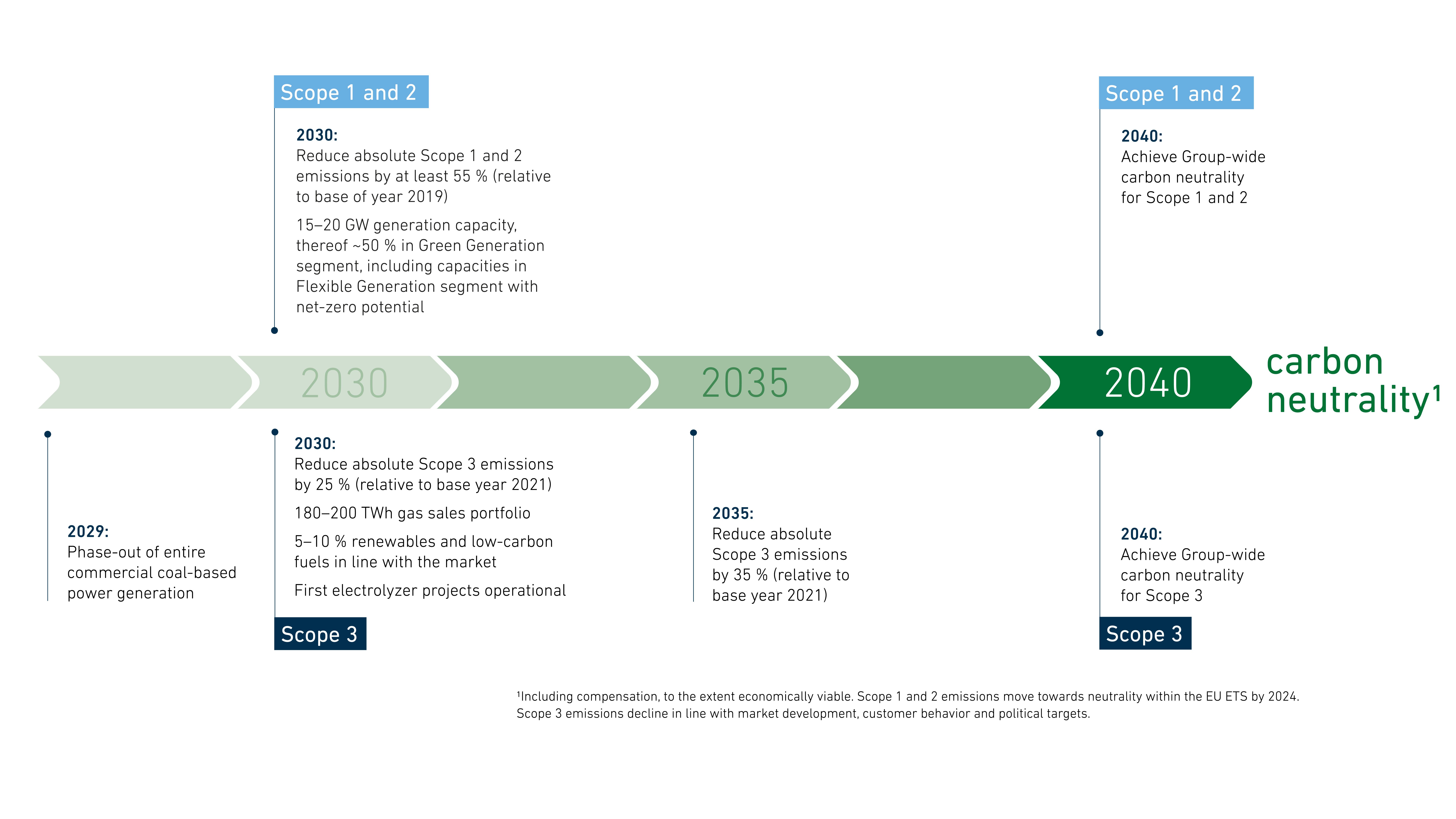
Phasing out commercial coal-fired power generation
Reduce our GHG emissions for Scope 1 & 2 by at least 55% compared to the base year 2021
Reduce our GHG emissions for Scope 3 by 25% by 2030 and by 35% compared to the base year 2021
By 2030, about 80% of our capacity should come from Green Generation
Group-wide CO₂ neutrality by 2040
Lower-carbon transformation of our gas-fired power plants
Acceleration of onshore wind and solar expansion, supported by flexible battery storage systems at renewable energy sites
Participation in the development of hydrogen-related infrastructure
Optimizing the potential of our hydropower and nuclear energy plants
To achieve our goals, we invested around €200 million in fiscal year 2024 — including in hydrogen projects, battery storage initiatives, and initial investments in the revitalization of the Happurg pumped-storage power plant. By the early 2030s, we plan to invest a total of approximately €8 billion in transforming our company.
Direct emissions:
Company vehicles, Own energy generation, Production
Indirect emissions through purchased energy:
Purchased energy [Electricity, Heating, Steam, Cooling]
Further indirect emissions:
Transport and delivery, purchased goods and services, business travels, waste disposal
The “Green Generation” business segment encompasses both renewables and nuclear power generation plants operated by the Uniper Group in Europe. In detail, these are Uniper’s hydropower plants (run-of-river, storage, and pumped-storage plants) in Germany and Sweden and the nuclear power plants in Sweden as well as our wind and solar power developments. To achieve climate-neutral power generation, renewable sources will play a crucial and increasing role in the future. For this reason, in the Green Generation segment we are focusing on the development, construction, and operation of wind and solar plants in various European countries. Furthermore, we are investing into the modernization and extension of selected hydro assets.
The expanded use of renewables alongside the retirement of significant parts of today’s fossil-fired generation capacity in Uniper’s core markets increases the need for flexible generation. The "Flexible Generation" business segment includes power and heat generation plants operated by Uniper in Europe to meet the requirements of network operators for grid stability and supply security, especially when renewables generation plants are not sufficiently available, for example, during times of “Dunkelflaute,” a simultaneous occurrence of darkness and a lull in wind activity.
For this purpose, gas-fired power plants, and, if necessary, coal and oil power plants are used to make an important contribution to supply security in Uniper’s core markets. To support the transition towards decarbonization while continuously aiming to fulfill that crucial role, we plan to entirely phase out our commercial coal-fired generation portfolio by 2029, convert parts of our gas-fired generation portfolio, and build new dispatchable capacities with net-zero potential. Existing gas-fired power plants are to remain in the portfolio in the long term, as well as new builds, which will increasingly be able to use hydrogen or other low-carbon fuels as well as Carbon Capture and Storage (CCS) and Carbon Capture and Usage (CCU) technologies.
Since full decarbonization will take time, we anticipate that natural gas will continue to be a crucial energy source globally in the coming years. The “Greener Commodities” business segment consolidates energy trading and optimization activities and serves as the commercial interface between the Uniper Group, global trading markets, and major customers.
Uniper’s gas portfolio consists of long-term agreements with gas suppliers, shorter-term purchases, distributing natural gas to resellers, large industrial customers, and power plants, or selling it on international markets. Additionally, this segment includes gas storage operations and other infrastructural investments such as the LNG business. It is planned that the "Greener Commodities" segment will increasingly import, trade, and, in some cases, process or store renewable and low-carbon gases and fuels such as biomethane, hydrogen, and hydrogen derivatives such as ammonia or methanol. While hydrogen is a key focus area for us, we are also growing our portfolio of renewable Power Purchase Agreements (PPA) and Guarantees of Origin (GoO).
By the end of 2024, we launched several new projects in the field of renewable energy. Over the next few years, approximately €140 million will be invested in five photovoltaic projects in Germany, the UK, and Hungary, with a combined capacity of over 230 megawatts. By 2030, Uniper aims to further expand its project portfolio and plans to develop around 8 gigawatts up to the Ready-to-Build (RTB) phase.

Our direct greenhouse gas (GHG) emissions totaled 14.2 million tonnes in fiscal year 2024 (previous year: 19.4 million tonnes). The reduction of around 27% was primarily due to the cessation of commercial operations at the German coal-fired power plants Staudinger 5 and Scholven B, as well as the decommissioning of Heyden 4 in Germany and Ratcliffe in the United Kingdom
Even today, around 50% of our electricity generation already comes from the Green Generation segment.
The planned commercial phase-out of coal in 2029 is expected to reduce emissions by over 9 million tonnes of CO₂e per year, compared to the base year 2019.
In the area of renewable gases, we have added bio-LNG to our portfolio. This makes Uniper the first company to use bio-LNG production capacity to convert biomethane into Bio-LNG at the gate terminal in Rotterdam.
The “Energiepark Bad Lauchstädt” project in Germany, which has been under construction since 2023, is an example of the implementation of our strategy in the “Greener Commodities” segment by combining renewable hydrogen production with storage, transportation and distribution.
We have concluded a five-year contract with Deutsche Bahn to supply it with electricity from hydropower.
We have developed a comprehensive strategy for climate protection and our contribution to mitigating climate change. This strategy involves setting clear, measurable targets for reducing CO₂ emissions and includes the implementation of our offsetting measures in all business areas.
Around two thirds of our total electricity and heat production already comes from hydroelectric, nuclear and gas-fired power plants. At the same time, we are in the process of closing coal-fired power plants in Europe and converting existing natural gas-fired plants to use renewable fuels (e.g. biofuels). We are pushing ahead with the construction of wind and solar parks at full speed by making substantial investments. As a result, we expect our CO₂ intensity to steadily decrease. We are consistently integrating climate protection and energy efficiency measures into our business processes and value chains and promoting the use of innovative new technologies for decarbonization. In doing so, we develop solutions that conserve resources and use energy more intelligently. In short, we are taking measures in all our business areas to achieve our GHG reduction targets. We will offset any remaining CO2 emissions up to CO2 neutrality through high-quality offsetting, where economically viable.

One of the most important decarbonization measures as part of our corporate strategy is the early phase-out of commercial coal-fired power generation by 2029. The closure of the last coal-fired power plant in the UK in Ratcliffe-on-Soar and the Heyden 4 power plant in Germany in September 2024, the decommissioning of our coal-fired power plant in Maasvlakte 3 in the Netherlands by the end of 2029 and the sale of the Datteln 4 hard coal-fired power plant are just the beginning.
However, several of our coal-fired power plants (Scholven B and C, Staudinger 5) were recently classified as system-relevant, meaning that their decommissioning dates were postponed in order to ensure the secure functioning of the German electricity supply system.
Our sites are conveniently located and have useful infrastructure such as connections to the high-voltage and district heating networks as well as rail links. We have therefore developed master plans to ensure that they have a viable future in an increasingly decarbonized world - and that we secure as many jobs as possible. For example, we will use some sites for hydrogen production and convert others to gas. At Uniper's Scholven coal-fired power plant in North Rhine-Westphalia, the conversion to gas is already in full swing.

We are already one of the largest operators of hydropower plants in Europe and make a key contribution to the energy supply. Our hydropower plants generate reliable energy - around the clock. In Germany and Sweden, we are pursuing projects to expand hydroelectric power generation. These projects build on existing infrastructure, e.g. the revitalization of the Happurg pumped storage power plant in Germany or the increase in capacity at a power plant on the River Umein Sweden.

In order to ensure a climate-neutral and reliable energy supply, we are making targeted investments in the expansion of renewable energies and innovative technologies, including modern storage solutions. Our declared goal is to end our dependence on fossil fuels as quickly as possible, in line with energy policy requirements and while maintaining security of supply. By 2030, we want to develop projects with a total volume of 8 GW for the generation of renewable energies until they are ready for construction (ready-to-build).

Even though the last three remaining nuclear power plants in Germany were shut down in 2023, nuclear energy continues to receive broad support as a low-carbon energy source in Northern Europe. Sweden currently obtains around 30 percent of its electricity from nuclear energy and we are co-owners of all three active nuclear power plants there: OKG, Ringhals and Forsmark. We feel a high degree of responsibility for always ensuring the safety and responsibility of the plants over their entire service life. This applies from the start of safe operation through to responsible dismantling.

We are one of Europe's leading gas traders and procure gas from various producers both via pipelines and as liquefied natural gas (LNG). It is our duty to make a reliable contribution to the secure energy supply of large parts of German industry as well as cities and municipalities throughout Germany and Europe. At the same time, we are focusing more and more on renewable and low-carbon gases such as hydrogen. We want to achieve this mainly through the following measures:
We are gradually adding renewable and low-CO2 gases such as hydrogen and biomethane to our gas portfolio with the aim of switching to these raw materials in the long term. However, as the transition to a hydrogen economy requires considerable effort from all relevant economic players, this transition will take time. Nevertheless, we are investing in projects that support the increasing use of renewable or low-CO2 fuels.
For us, hydrogen is the key to a climate-friendly energy future, alongside renewable energies and hydropower. It is of crucial importance for the decarbonization of important sectors such as the steel and chemical industries. We would therefore like to contribute to the development of the European hydrogen economy. As part of this, we intend to convert our decommissioned coal-fired power plant in Wilhelmshaven into a major hydrogen hub. We assume that this hub could cover around 15 % of Germany's hydrogen requirements by 2030. We are also in the process of developing similar hubs in the Netherlands and the UK. In addition, we are promoting the development of new hydrogen solutions through cooperation with various partners such as the German H2Global initiative.
We are also investing in projects such as the pilot storage facility opening in Krummhörn in 2024, which will test the use of a salt cavern to store renewable hydrogen under real operating conditions. We are already implementing the production, transportation and storage of hydrogen at the Bad Lauchstädt Energy Park.
Renewable and low-carbon ammonia is playing an increasingly important role as an energy source and raw material on the road to decarbonization. We see a particular focus for us on the sale of so-called “green” and “blue” ammonia. We are therefore already preparing for trade, even if these variants are not yet produced on a large scale.


