
From operation to dismantling
In Sweden, extensive work is now underway to dismantle six of the country's twelve commercial reactors, with Uniper responsible for dismantling Barsebäck 1 and 2 and Oskarshamn 1 and 2.
First out was the Barsebäck plant, which was closed following political decisions in 1999 and 2005. This was followed by Oskarshamn 1 and 2, which were decommissioned between 2015 and 2017 after many years of service to society.
The work is being carried out by Uniper Nuclear Services (UNS) in a coordinated program where experiences and methods are further developed between projects – a working method we call Lead and Learn.
Decommissioning in numbers
of 12 reactors are currently being decommissioned
%
of all material can be recycled
%
of the material is radioactive
radiological demolition expected to be completed
From demolition to recycling
Demolishing a nuclear power plant is not about throwing things away – it's about making use of them.
Approximately 95 percent of all material can be recycled. Steel, concrete, and other components that are no longer radioactive are declassified and sent for recycling.
Through collaborations with specialized companies, such as Cyclife, the recycling rate has increased further. New methods for cleaning and declassification directly on site have made the process both faster and more resource-efficient.
As mentioned, the demolition of the reactors at Ringhals has little to do with us, other than that we are minority owners.
The radiological demolition of Barsebäck 1 and 2 and Oskarshamn 1 and 2 is expected to be completed in 2028.
A multi-stage process
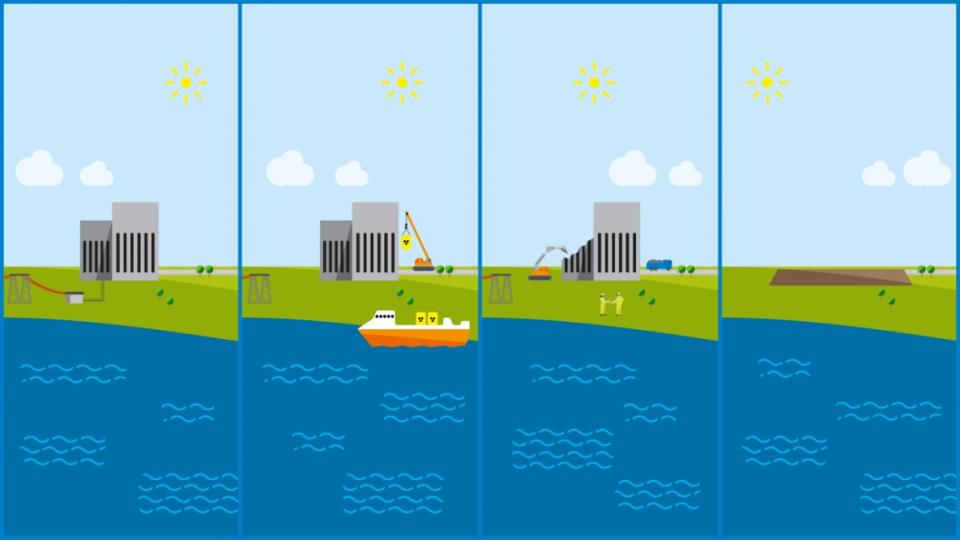
Demolition takes place from the inside out. The most active waste is removed first, after which the remaining parts of the facility are dismantled according to a carefully planned schedule.
In total, approximately 5 percent of the material (67,000 tons) consists of radioactive material, most of which is low-level. Half of this can be treated as conventional waste and recycled.
When the work is complete, the land will be restored to industrial land, with the same radiation level as the surrounding environment, ready for future activities.
Responsibility for nuclear waste
Regardless of the future energy mix, there is already nuclear waste that must be dealt with in the short and long term. The responsibility lies entirely with the nuclear power companies, which, through the Swedish Nuclear Fuel and Waste Management Company (SKB), run Sweden's largest environmental protection project.
When the work is complete, the land will be restored to industrial land, with the same radiation level as the surrounding environment, ready for future activities.
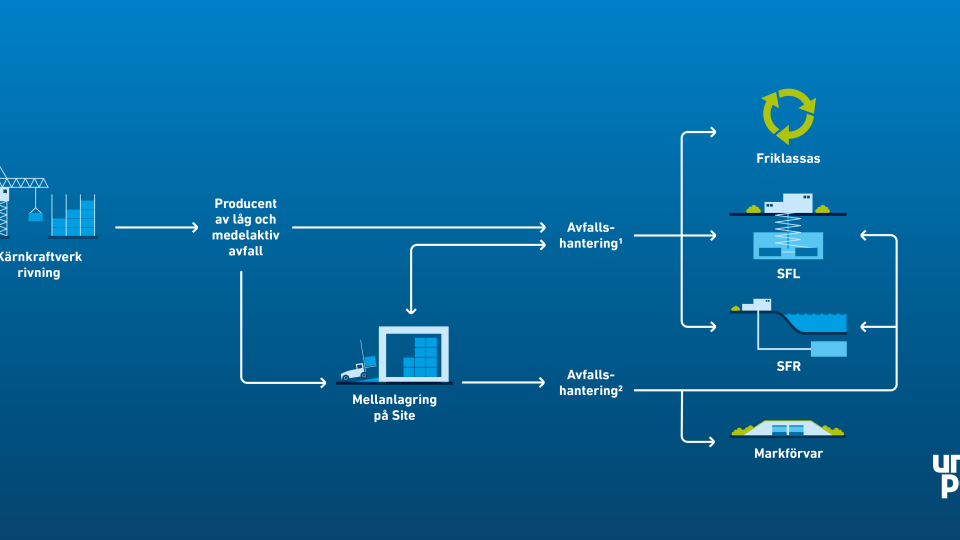
The system for managing radioactive waste consists of several facilities that together form a secure chain – from interim storage to future final disposal in Forsmark. Unipers facilities in Barsebäck and Oskarshamn have their own interim storage facilities that safely store the waste until it can be transported further.
Financing through the Swedish Nuclear Waste Fund
According to Swedish law, nuclear power companies are responsible for all the costs of managing nuclear waste, including its final repository. They are also obligated to defray the dismantling costs for nuclear power plants and other nuclear facilities.
Since the mid-1970s, nuclear power companies have put aside money to cover these costs, first as allocations in their own balance sheets and then, since 1982, in the Swedish Nuclear Waste Fund.
SKB regularly calculates the future costs of managing nuclear waste and submits the calculation every three years to SSM. After the review, SSM proposes fees for the coming years to the government, who determines their exact amount.
Historically speaking, fees paid by nuclear power companies have varied between one and two Swedish öre per delivered KWh of electricity. In 2021, for example, Swedish reactor owners paid fees between 3.0 and 5.6 Swedish öre per delivered KWh of energy into the fund. In addition to the fees paid by nuclear power companies, financial guarantees are established to cover fees that have not yet been paid to the fund and for unforeseen events.
Even after a reactor has been permanently shut down, a nuclear power company is obligated to pay fees under Swedish law. If all of the reactors at a site have been permanently shut down, as is the case with Barsebäck, any deficit in the fund is covered through a direct payment from the owner of the facility.


